
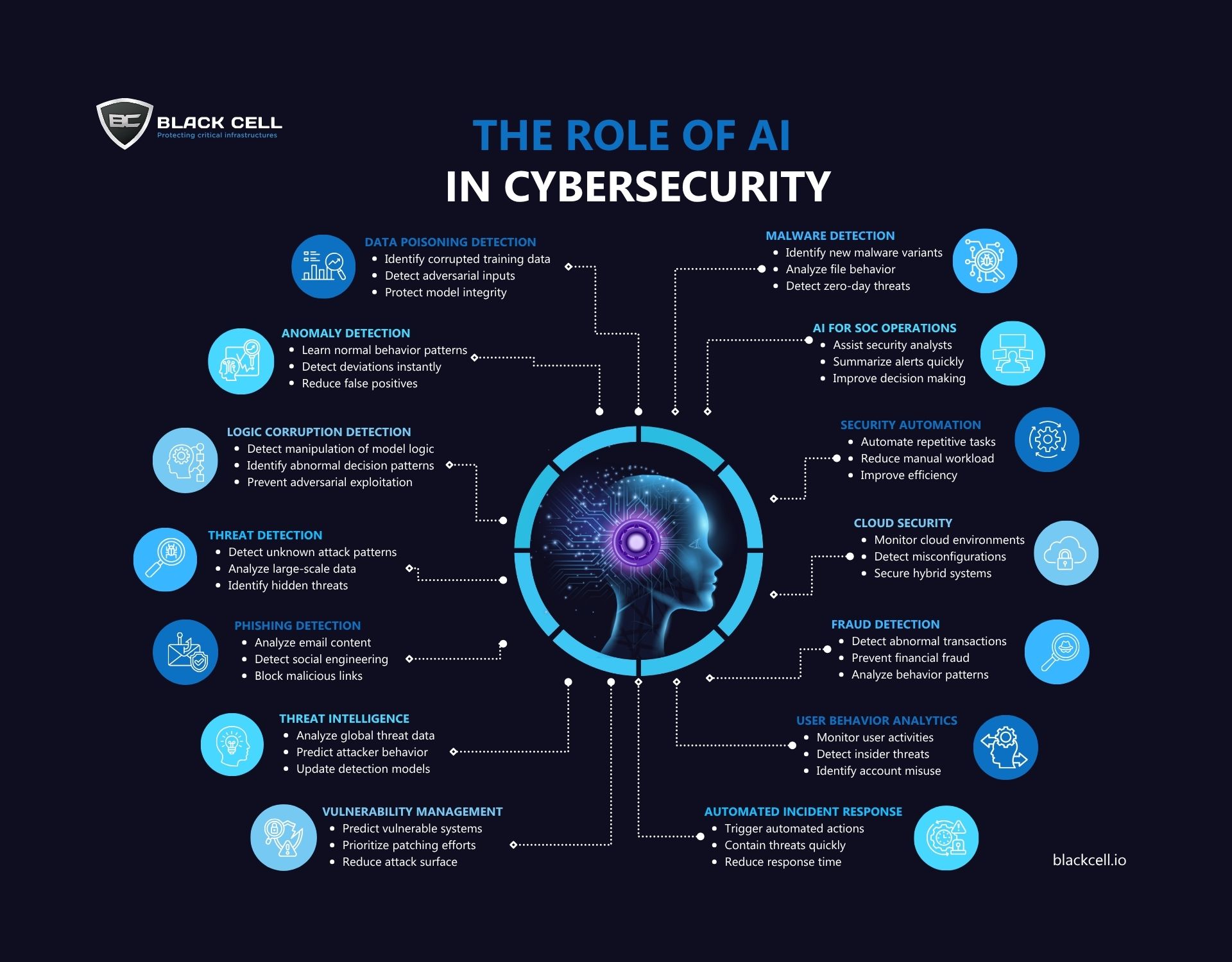
Artificial intelligence is transforming cybersecurity by helping organizations detect threats faster, reduce manual workload, and improve response capabilities. As cyberattacks become more sophisticated, AI enables security teams to move from reactive defense to proactive protection.
AI supports cybersecurity in many ways – from identifying malware variants and phishing attempts to detecting anomalies, insider threats, and suspicious behavior patterns. It also strengthens Security Operations Centers (SOCs) by helping analysts prioritize alerts, automate repetitive tasks, and accelerate incident response.
Beyond threat detection, AI improves vulnerability management, cloud security, fraud prevention, and threat intelligence by analyzing vast amounts of data and uncovering risks that traditional methods may miss.
While AI is not a replacement for cybersecurity professionals, it has become an essential force multiplier – helping organizations stay one step ahead in an increasingly complex threat landscape.
#ai #blackcell
Author

Tibor Luter
FUSION CENTER MANAGER
Related Posts

Threat actors target WordPress sites using vulnerable File Manager install
In early September, experts reported that hackers were actively exploiting a critical remote code execution vulnerability in the File Manager WordPress plugin that could be exploited by unauthenticated attackers to upload scripts and execute arbitrary code on WordPress sites running vulnerable versions of the plugin.

Serious Security: Hacking Windows passwords via your wallpaper
We’re all aware of the risks posed by unknown EXE files, for example, because EXE is the extension for native Windows programs – even the operating system itself is implemented as a collection of EXEs.