
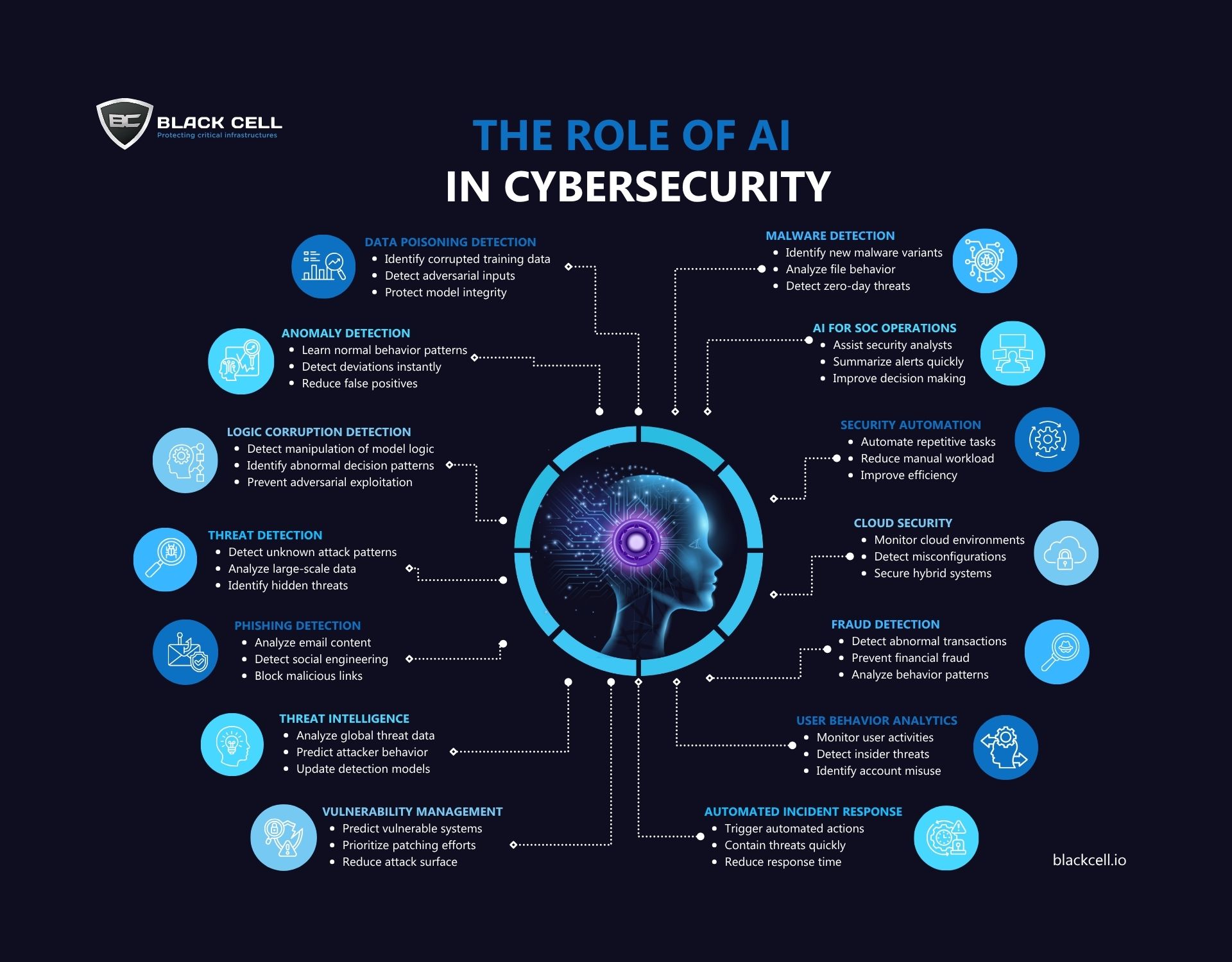
Artificial intelligence is transforming cybersecurity by helping organizations detect threats faster, reduce manual workload, and improve response capabilities. As cyberattacks become more sophisticated, AI enables security teams to move from reactive defense to proactive protection.
AI supports cybersecurity in many ways – from identifying malware variants and phishing attempts to detecting anomalies, insider threats, and suspicious behavior patterns. It also strengthens Security Operations Centers (SOCs) by helping analysts prioritize alerts, automate repetitive tasks, and accelerate incident response.
Beyond threat detection, AI improves vulnerability management, cloud security, fraud prevention, and threat intelligence by analyzing vast amounts of data and uncovering risks that traditional methods may miss.
While AI is not a replacement for cybersecurity professionals, it has become an essential force multiplier – helping organizations stay one step ahead in an increasingly complex threat landscape.
#ai #blackcell
Author

Tibor Luter
FUSION CENTER MANAGER
Related Posts

Extend visibility across your entire cloud environment
We are excited to announce that Intercept X for Server Advanced with EDR has been enhanced with powerful cloud visibility features from Cloud Optix.
In addition to even more detail on your AWS, Azure, and GCP cloud workloads, this integration gives customers critical insights into their wider cloud environments, including security groups, hosts, shared storage, databases, serverless, containers, and more.
Iranian hacker group becomes first known APT to weaponize DNS-over-HTTPS (DoH)
An Iranian hacking group known as Oilrig has become the first publicly known threat actor to incorporate the DNS-over-HTTPS (DoH) protocol in its attacks. Speaking in a webinar last week, Vincente Diaz, a malware analyst for antivirus maker Kaspersky, said the change happened in May this year when Oilrig added a new tool to its hacking arsenal.