
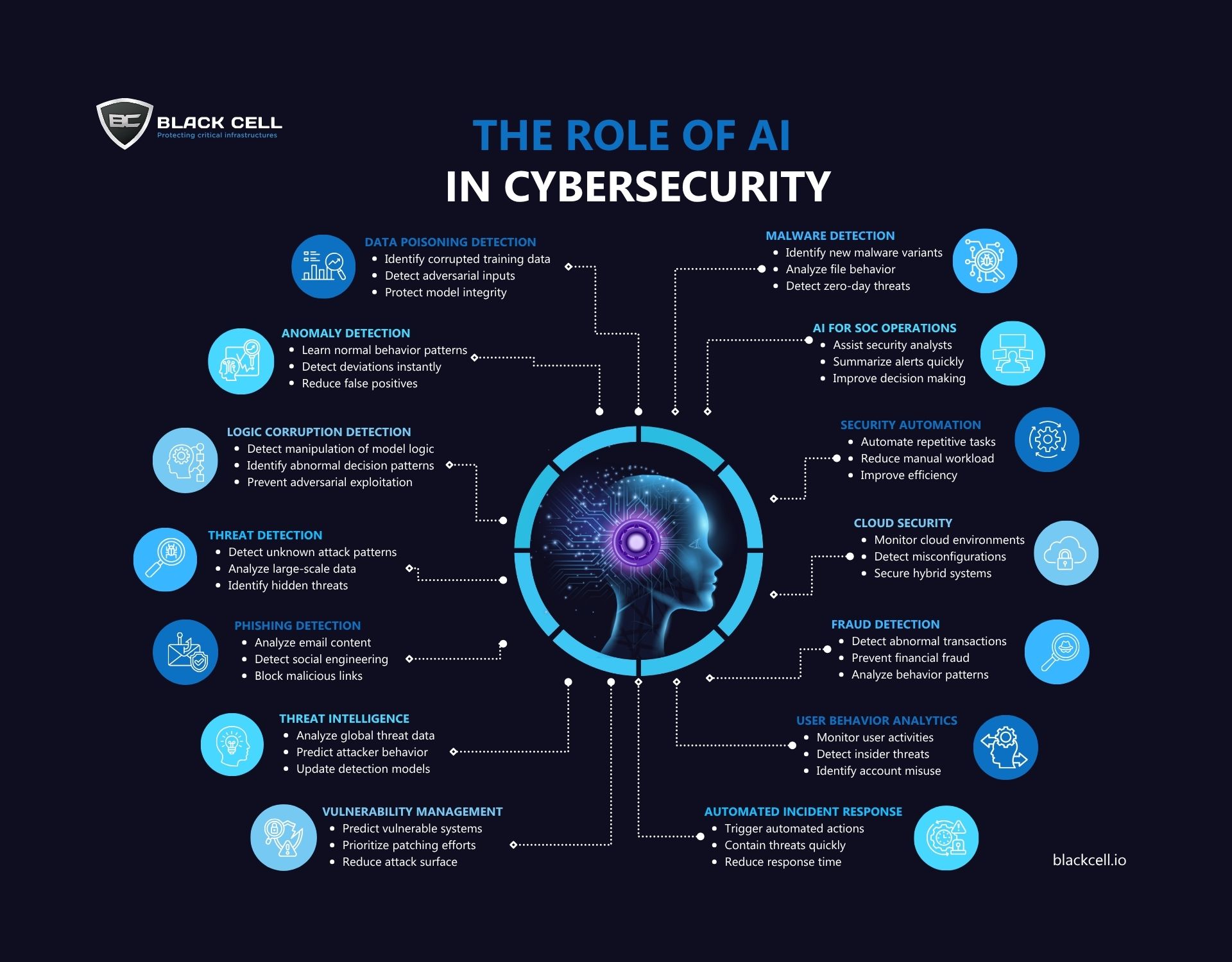
Artificial intelligence is transforming cybersecurity by helping organizations detect threats faster, reduce manual workload, and improve response capabilities. As cyberattacks become more sophisticated, AI enables security teams to move from reactive defense to proactive protection.
AI supports cybersecurity in many ways – from identifying malware variants and phishing attempts to detecting anomalies, insider threats, and suspicious behavior patterns. It also strengthens Security Operations Centers (SOCs) by helping analysts prioritize alerts, automate repetitive tasks, and accelerate incident response.
Beyond threat detection, AI improves vulnerability management, cloud security, fraud prevention, and threat intelligence by analyzing vast amounts of data and uncovering risks that traditional methods may miss.
While AI is not a replacement for cybersecurity professionals, it has become an essential force multiplier – helping organizations stay one step ahead in an increasingly complex threat landscape.
#ai #blackcell
Author

Tibor Luter
FUSION CENTER MANAGER
Related Posts

Various social engineering techniques aka „Layer 8” attack vectors
Information security is important for every organisation and individual. But there is a fake idea that they can protect their datas with the most expensive cyber security softwers and tools. Not taking into a consideration, that these softwers and tools are as much strong as the weakest link in their organisation. That’s actually the human. The naivety, kindness and curiosity can easily lead to the leak of critical information.
Why packet capture is an important tool in the threat hunting toolbelt
With IT security technology rapidly improving, an increasing number of organizations are turning towards analytics, AI, and automation to help with managing the complex task of detecting and remediating cyber-attacks as well as to assist in reducing dwell time. These tools are becoming increasingly advanced by the day, and have become the industry standard for IT security. On the other hand, many of the cybersecurity tools used nowadays utilize predefined rules and signatures to identify malicious activity.