
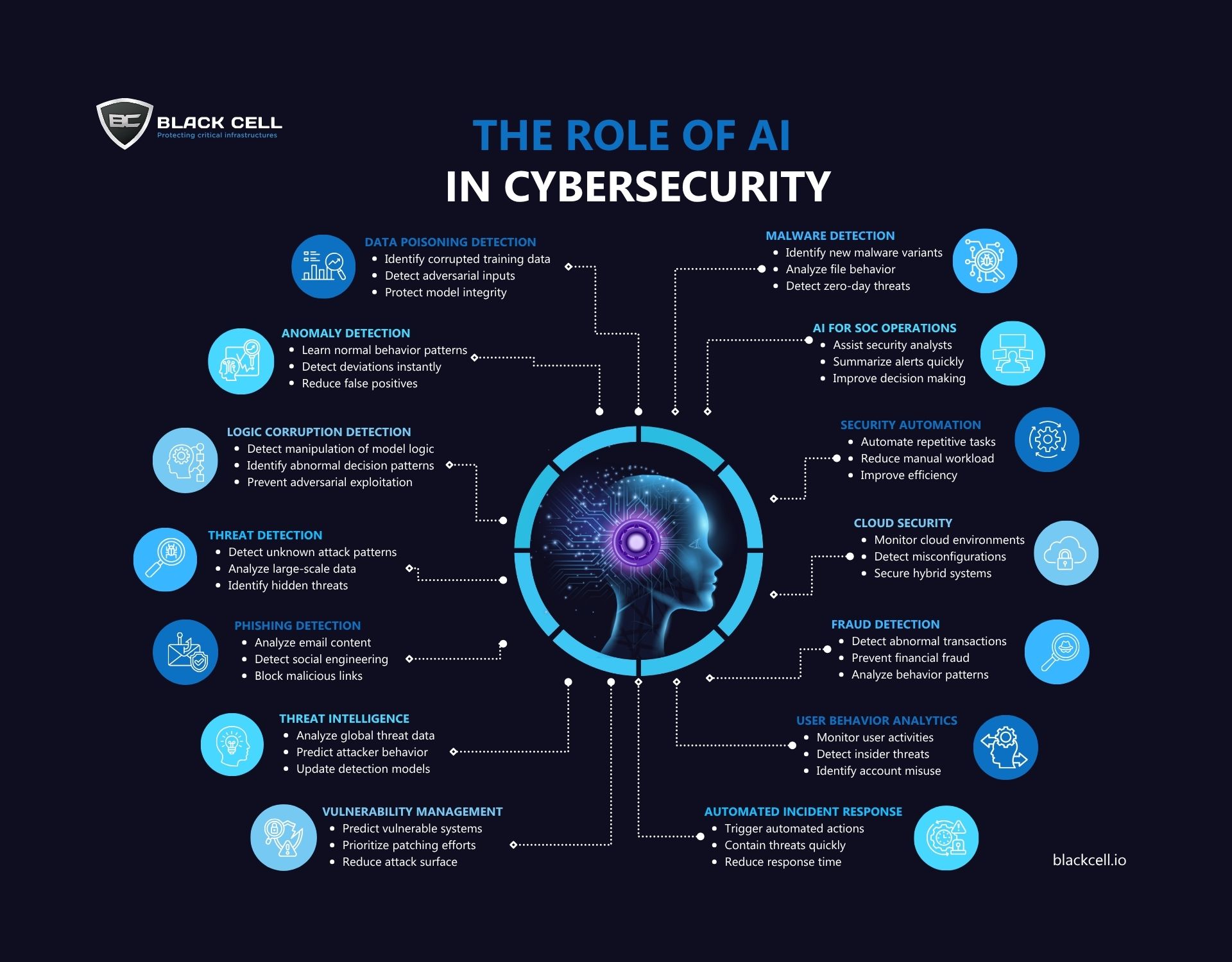
Artificial intelligence is transforming cybersecurity by helping organizations detect threats faster, reduce manual workload, and improve response capabilities. As cyberattacks become more sophisticated, AI enables security teams to move from reactive defense to proactive protection.
AI supports cybersecurity in many ways – from identifying malware variants and phishing attempts to detecting anomalies, insider threats, and suspicious behavior patterns. It also strengthens Security Operations Centers (SOCs) by helping analysts prioritize alerts, automate repetitive tasks, and accelerate incident response.
Beyond threat detection, AI improves vulnerability management, cloud security, fraud prevention, and threat intelligence by analyzing vast amounts of data and uncovering risks that traditional methods may miss.
While AI is not a replacement for cybersecurity professionals, it has become an essential force multiplier – helping organizations stay one step ahead in an increasingly complex threat landscape.
#ai #blackcell
Author

Tibor Luter
FUSION CENTER MANAGER
Related Posts
Why Proxy-Based Firewalls Are Not Enough
The first proxy-based firewalls achieved the basic task of controlling which websites users could access on the Internet. Since then, the technology has developed and evolved to provide additional features like malware detection and blocking, in-line data loss prevention (DLP), SSL/TLS inspection and bandwidth control.

Coronavirus panic at the service of government-backed hacker groups
As we wrote in a previous post, the current pandemic is an excellent source of cyber attacks (as well). However, it is not only profit-making that is behind these operations, but the political, ideological load is at least as crucial as monetization. For groups with a state background (almost infinite availability of financial, material and human resources), another phenomenon has emerged at the global level, affecting most people (in this case everyone).