
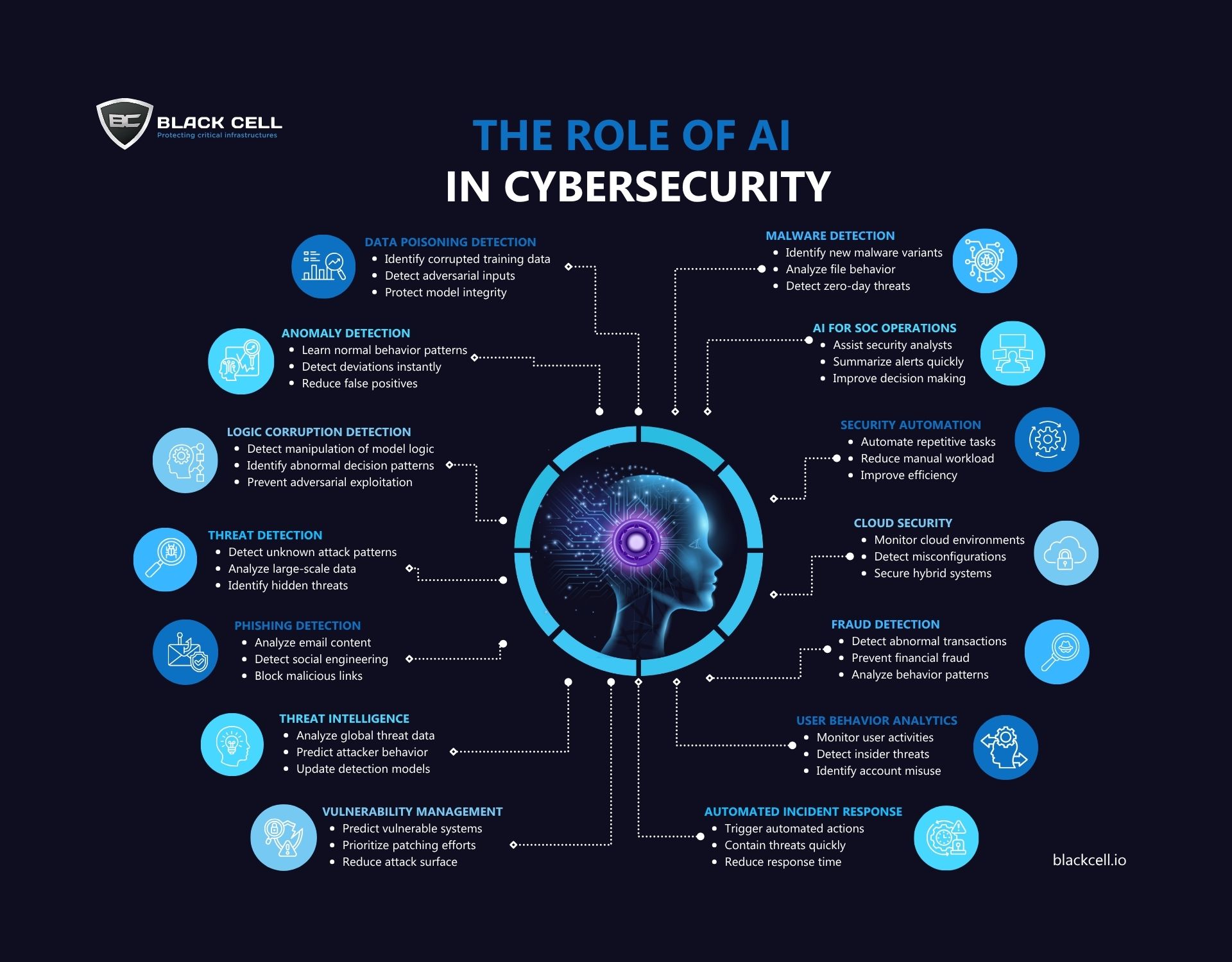
Artificial intelligence is transforming cybersecurity by helping organizations detect threats faster, reduce manual workload, and improve response capabilities. As cyberattacks become more sophisticated, AI enables security teams to move from reactive defense to proactive protection.
AI supports cybersecurity in many ways – from identifying malware variants and phishing attempts to detecting anomalies, insider threats, and suspicious behavior patterns. It also strengthens Security Operations Centers (SOCs) by helping analysts prioritize alerts, automate repetitive tasks, and accelerate incident response.
Beyond threat detection, AI improves vulnerability management, cloud security, fraud prevention, and threat intelligence by analyzing vast amounts of data and uncovering risks that traditional methods may miss.
While AI is not a replacement for cybersecurity professionals, it has become an essential force multiplier – helping organizations stay one step ahead in an increasingly complex threat landscape.
#ai #blackcell
Author

Tibor Luter
FUSION CENTER MANAGER
Related Posts

SIEM is not enough, widening SOC visibility with open source tools
For a SOC (Security Operations Center) it is vital to continuously be informed about the events of the monitored network on a centralized platform. The SIEM (Security Information and Event Management) system performs this task. It harvests the information from various log sources and – in accordance with the settings – generates security events.
NETWORK THREAT HUNTING WITH NETFLOW
Threat hunting is a good old process in the field of Cybersecurity. It covers human-driven analytics and searching through datasets (networks, endpoints, security solutions, etc.), in order to detect malicious activities, which could’ve evaded detection by existing IDPS or other automated detections.